
Roman Republic and Imperatorial Coins
|
The Roman Republic (est. 509 BC) was a masterclass in political balancing. Driven by a deep-seated hatred of kings, Romans built a system centered on shared power, governed by the Senate and two Consuls who held veto power over one another. It was a "mixed" constitution designed to ensure that no single man could ever claim the title of Rex again. However, as Rome’s borders expanded, the system began to buckle. This led to the Imperatorial era, a chaotic transition where the "rule of law" was replaced by the "rule of the sword." During this period, charismatic generals—most notably Julius Caesar, Pompey, and Marc Antony—leveraged professional armies whose loyalty belonged to their commanders rather than the state. The era ended when Octavian (Augustus) consolidated power in 27 BC, effectively trading the Republic's messy freedom for the structured stability of the Roman Empire. |
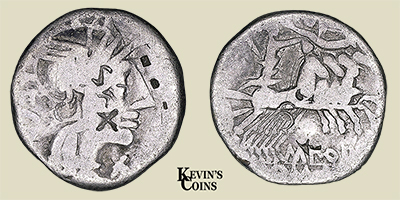
AR Denarius. Marcus Porcius Laece 125 B.C. Rome (16mm, 3.58g)
Obv: LAECA Helmeted head of Roma right,  (XVI monogram) in right field. Banker marks on face and right field
Rev M. PORC Libertas in fast quadriga right, crowned by Victory flying left, ROMA in exergue. Bankers marks
Sear 146, RRC 270/1, CRR 513, RSC Porcia 3
Ex Vel Garnet collection
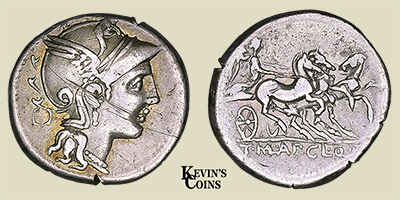
AR Denarius Appius Claudius Pulcher T. Mallius or Maloleius (or T. Manlius Mancinus) and Q.
Urbinius moneyers 111-110 B.C.
Rome (17mm 3.88g)
Obv:Helmeted head of Roma right, quadrangular device containing circle behind
Rev: Victory in triga right T MAL AP CL Q VR below
Sear 176 Crawford 299/1a
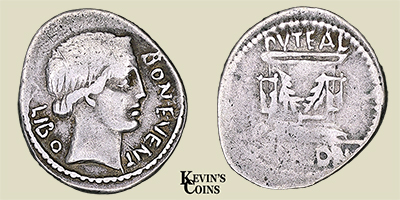
AR Denarius L. Scribonius Libo 62 B.C.
Rome (21.5mm 4g)
Obv: Diademed head of Bonus Eventus r. BON EVENT before, LIBO behind
Rev: The Puteal Scribonianum decorated with garland between two lyres and a hammer at base PVTEAL above SCRIBON below.
Sear 367, RRC 416/1. CRR 9287, RSC Scribonia 8-8b
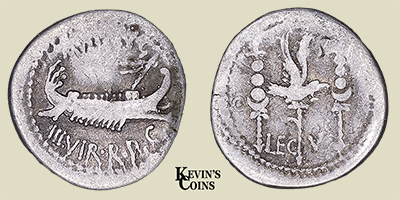
Imperatorial Coinage
Marc Antony Legionary Silver Denarius 19mm (3.15g) 32-31 B.C. Military mint
Obv: ANT. AVG III.VIR.R.P.C War galley
Rev: Legionary eagle between two standards LEG V beneath
Cr-544/18, Syd-1221, C-32

