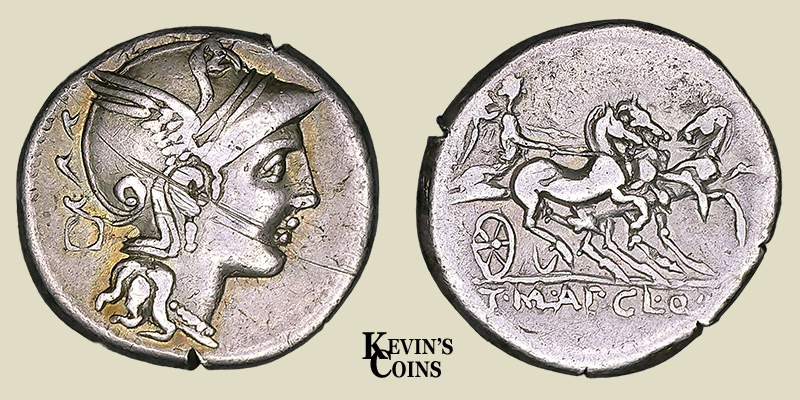
AR Denarius Appius Claudius Pulcher 62 B.C. Rome


AR Denarius Appius Claudius Pulcher T. Mallius or Maloleius (or T. Manlius Mancinus) and Q.
Urbinius moneyers
 111-110 B.C.
Rome (17mm 3.88g)

Obv:Helmeted head of Roma right, quadrangular device containing circle behind

Rev: Victory in triga right T MAL AP CL Q VR below

Sear 176 Crawford 299/1a
ex Caribou Coins (Jon Moller)

1. The Front (Obverse): Roman Pride

  • The Portrait: You see the profile of a woman wearing a winged helmet. This is Roma, the personification of the city of Rome itself. In the Republic, long before emperors put their own faces on coins, money featured gods and national symbols.
  • The Weird Box: Behind her head, there is a small "quadrangular device containing a circle" (a square with a circle inside). Earlier numismatists proposed it represented a corn-measure or a voting tablet, but modern scholarship suggests its exact significance remains unexplained. 

2. The Back (Reverse): Victory & Teamwork

  • The Chariot: This is the most exciting part! It shows Victoria (the goddess of Victory) driving a triga—a three-horse chariot. Most Roman coins show a biga (two horses) or a quadriga (four horses). A three-horse chariot is incredibly rare on Roman coins, making this a very interesting collector's piece.
  • The Mystery Letters: The text at the bottom reads T MAL AP CL Q VR. It is a jumble of abbreviations squished together (called ligatures). It spells out the names of the three guys in charge of the mint that year: T. Mallius or Maloleius (or T. Manlius Mancinus), Ap. Claudius Pulcher, and Q.
    Urbinius.

According To David Sear in Roman Coins And Their Values Volume 1
"The identities of the second and third moneyers are quite uncertain and Q VR has often been expanded as quaestores urbani. Crawford believes the MAL monogram is better resolved as MANL. Another variety has T MAL AP CL Q VR (MAL and VR in monogram) in ex. The three-horse chariot (triga) is rarely depicted on the Republican coinage, the only other example being on serrate denarii of C. Naevius Balbus issued some three decades later in the time of Sulla"

The Takeaway

This little piece of silver was basically a political business card. By putting their names underneath the Goddess of Victory and the face of Roma, these three young politicians were telling the public, "We are the future leaders of Rome, we honor our city, and we bring victory!"

Site hosted free courtesy of VCoins.com
Ancient Coins on Vcoins

Untitled 1

In an effort to spare you my horrible grammar and spelling, I use artificial intelligence to assist in content creation.

Visit My Blog

logo

Email Kevin

*