
|
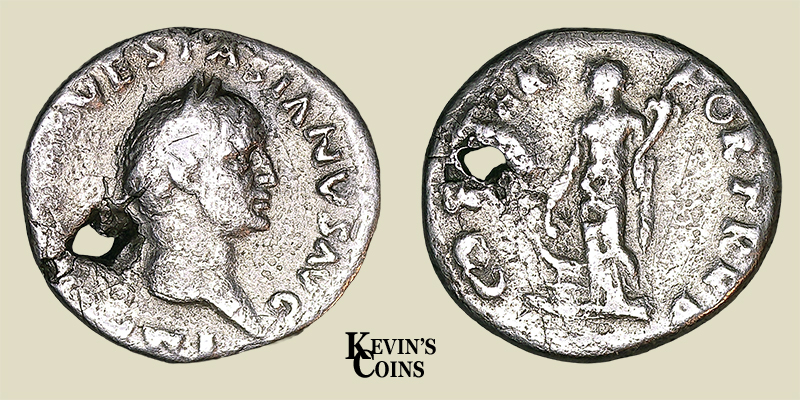
Silver Denarius (18.5mm 2.98g) Struck AD 69-71 Rome Obv: IMP CAESAR VESPASIANVS AVG, Laureate head right Rev: COS ITER FORT RED Fortuna standing left holding rudder and cornucopia. Hole appears to have been made in antiquity RIC 4 (RIC 2nd Ed. 4) |
Listen.
In AD 69, the Roman Empire was behaving very much like a machine designed by a lunatic.
The Emperor Nero had recently committed suicide by forcing his private secretary to help him drive a dagger into his throat. He left no heirs, but he did leave a tremendous amount of structural damage, a bankrupt treasury, and a populace that was deeply confused about who was supposed to be in charge of the planet.
So it goes.
What followed is what historians call the Year of the Four Emperors. It was a game of musical chairs played with legions of heavily armed men. First came Galba, who was old and greedy and got hacked to pieces in the Forum by his own bodyguards. Then came Otho, who lost a big battle and stabbed himself to keep things tidy. Next was Vitellius, a man who loved to eat until he threw up, who was eventually dragged through the streets, tortured, and thrown into the Tiber River.
That brings us to the guy on the front of this coin: Vespasian.
Vespasian was not a fancy aristocrat. He was a practical, square-jawed tax collector’s son from the provinces who happened to be out east crushing a rebellion when he realized that Rome was entirely up for grabs. He had the backing of the eastern legions and, more importantly, he possessed a functioning brain. By December of AD 69, he was the last man standing.
To tell everyone that the slaughter was officially over and that the adults were back in charge, he minted this piece of silver—a denarius, cataloged by modern coin nerds as RIC 4.
If you look at the front side—the obverse—you see Vespasian’s face. He didn't ask the coin makers to make him look like a handsome, youthful god the way Nero did. He wanted to look like a tough, weathered old mule who knew how to balance a budget. The letters around his head say IMP CAESAR VESPASIANVS AVG. It was a way of saying, "Yes, the tax collector's son is the Caesar now. Deal with it."
The back side—the reverse—is where the real magic happens. It features a lady named Fortuna. She was the Roman goddess of luck, fate, and how things turn out. On this coin, she is holding a rudder and a cornucopia, which is a big horn full of vegetables and good things.
The words around her read COS ITER FORT RED. This is short for Consul Iterum Fortuna Redux, which translates roughly from Latin to: "The Emperor is Consul for the second time, and Good Fortune has finally come back home."
It was a piece of propaganda you could fit in your pocket. Rome had just spent a year burning itself to the ground, and Vespasian wanted a soldier in Gaul or a merchant in Egypt to look at this silver disk and think, "Thank goodness. The luck has returned. I can go back to making money."
There is one more thing about Kevin’s specific coin that you ought to notice. It has a hole punched right through it.
The website notes that this hole appears to have been made in antiquity. This means that a long time ago—perhaps while Vespasian was still breathing, or shortly after he died—some human being took a hammer and a nail, drove it through this piece of imperial propaganda, ran a string through it, and wore it around their neck.
Maybe they wore it as a lucky charm because they genuinely loved old Vespasian for stopping the civil wars. Or maybe they just needed a way to keep from losing their money while walking through a crowded market.
We will never know who that person was, what they smelled like, or what made them laugh. They are gone now, and so is the empire, mostly.
So it goes.

