
|
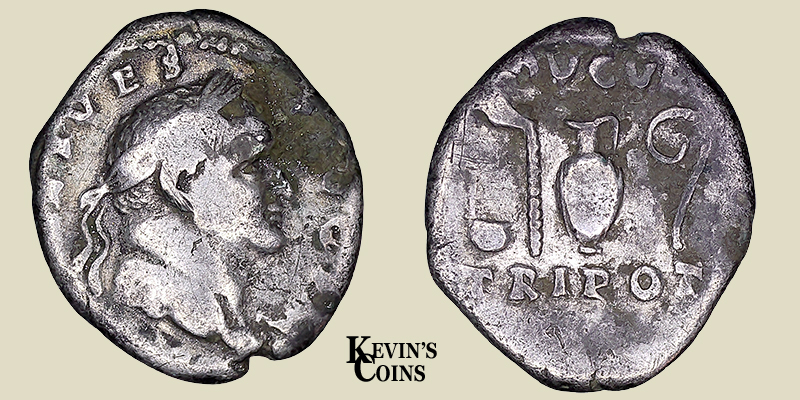
Silver Denarius (17mm 3.05g) Struck A.D. 70-72 Rome Obv: IMP CAES VESP AVG PM Laureate head right Rev: AVGVR TRI POT Priestly Implements, Simpulum, Aspergillum, Jug, and Litus RIC II 30 |
Well, now, if you take a close look at this little round slice of silver, you’re looking at a mighty fine piece of ancient political advertising. It’s a Roman denarius, minted right around A.D. 70 to 72, and it carries the heavy weight of a empire that had just about shaken itself to pieces.
To understand how this coin came to be, you have to understand the unholy mess Rome was in just a year prior. The year 69 was what the locals called the "Year of the Four Emperors." Old Emperor Nero had done the world a favor and departed the stage, leaving behind a vacuum that every ambitious general with an army thought he could fill. They went through three emperors—Galba, Otho, and Vitellius—faster than a deck of cards gets shuffled in a Mississippi riverboat casino. Each one stood on the balcony, wore the purple cape for twenty minutes, and then got murdered by the next guy.
By the time the dust settled, the fellow on the front of this coin, Vespasian, was the last man standing. Now, Vespasian wasn’t one of those high-born, blue-blooded Roman aristocrats who spent their days sipping watered-down wine and reciting poetry. No, sir, he was a plain-faced, practical old soldier from the middle class with a mule-breeder's background and a face that looked like it had been carved out of a hickory stump.
When he took over, Rome was flat broke and morally bankrupt. The people were jumpy, the treasury was as empty as a church piggy bank on Monday morning, and everybody was worried that the gods were thoroughly disgusted with the whole peninsula.
So, Vespasian did what any sensible politician would do when his crown is still a little slippery: he put out some propaganda.
On the front—the "obverse," if you want to use the high-toned dictionary words—he put his own mug. The Latin letters tell everyone he’s the Emperor, Caesar, and Pontifex Maximus (the high priest). He wanted everyone to see that sensible, rugged face and think, "There’s a man who pays his taxes, locks the back door at night, and won't burn the city down for a fiddle solo."
But it’s the back of the coin—the "reverse"—that really tells the story. You won’t find any grand pictures of marching soldiers or conquered barbarians there. Instead, it shows a neat little row of four priestly tools: a ladling spoon (simpulum), a sprinkler brush (aspergillum), a pitcher (jug), and a curved staff (lituus).
To the average Roman buying a loaf of bread, those tools sent a loud, clear message. They didn’t say "I am a mighty conqueror." They said, "Folks, the wild party is over. We are going back to the old-time religion. We’re going to clean up the temples, say our prayers, and get the gods back on our side." By emphasizing his role as an augur and priest, this rough old general was trying to coat his brand-new, military dictatorship in a thick lacquer of ancient, respectable tradition.
It worked, too. Vespasian stabilized the empire, started building the Colosseum, and even managed to die of old age in his own bed—a rare luxury for a Roman emperor in those days.
So, when you hold a silver piece like this, you aren't just looking at old pocket change. You're looking at the exact tool a gravel-voiced old soldier used to tell a terrified empire to calm down, take a deep breath, and trust that the grownups were back in charge.

