
|
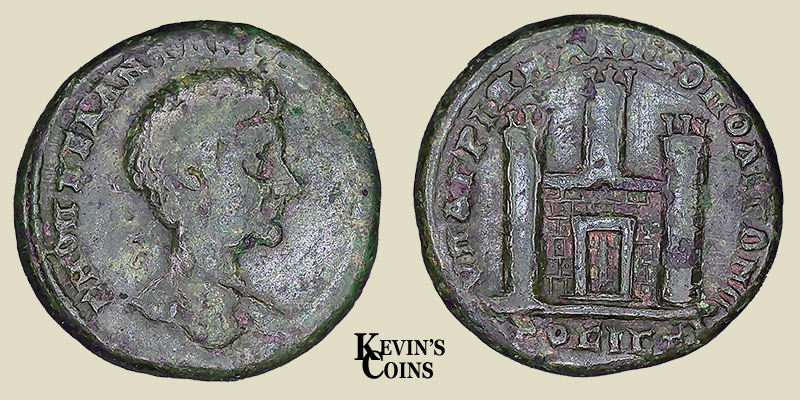
Diadumenian AE26 ( 25mm 7.56g) Moesia Inferior, Nicopolis ad Istrum AD 217-218 Obv: Κ Μ ΟΠΠΕΛ ΑΝΤΩΝΙ ΔΙΑΔΟΥΜΕΝΙΑΝΟϹ,(Marcus Opellius Antoninus Diadumenianus) Bare head right – seen from behind Rev: ΥΠ ΑΓPΙΠΠΑ ΝΙΚΟΠΟΛΙΤΩΝ ΠPΟϹ ΙϹΤ, (Consular legate Agrippa, (Governor) of the residents of Nikopolis on the (river) Istrus – providing strong protection to the people) City gate with three crenulated towers Varbanov 3637, Moushmov 1314 |
This coin captures a brief, chaotic, and ultimately tragic 14-month window in Roman history. It tells a story of an assassination, a desperate attempt to legitimize a new family dynasty, and the unique way the Roman Empire's border cities used money to pledge their loyalty.
Here is the historical context breakdown of what this bronze coin represents.
1. The Boy on the Obverse: Diadumenian’s Tragic Rise
In April AD 217, the tyrannical Roman Emperor Caracalla was assassinated by a disgruntled soldier. The man behind the plot was Caracalla's Praetorian Prefect (head of the imperial bodyguard), Macrinus.
Macrinus seized the throne, becoming the first emperor who wasn't a senator. Knowing the army loved Caracalla and might mutiny, Macrinus immediately did two things to secure his power:
- He elevated his 8-year-old son, Diadumenian, to the rank of Caesar (junior emperor/heir).
- He changed the boy's name to Marcus Opellius Antoninus to artificially link him to Caracalla's family tree.
The portrait on your coin shows Diadumenian as a young boy with a bare head (indicating he was a Caesar, not yet crowned full Augustus with a laurel wreath).
2. The Reverse: Why a City Gate in Nicopolis ad Istrum?
Nicopolis ad Istrum (located in modern-day northern Bulgaria) was a thriving Greek-speaking city in the Roman province of Moesia Inferior.
When a new emperor took over, provincial cities had to quickly strike new coins to announce the transition of power, advertise the face of the new ruler, and essentially say, "Look, we support you!"
The city gate with three towers on the back of this coin is a fascinating piece of propaganda and local pride:
- The Governor’s Stamp: The Greek inscription on the reverse names Marcus Claudius Agrippa, the provincial governor (consular legate) appointed by Macrinus. Agrippa oversaw the minting to prove his allegiance to the new regime.
- Security & Defense: Nicopolis sat right near the Danube River—the volatile northern frontier of the Roman Empire. The city gate imagery was a visual reminder of the city's fortification against barbarian invasions. It also sent a message to the new emperor: We are a strong, loyal fortress protecting your northern border.
3. The Graphic Finale
This coin was struck between mid-217 and mid-218. Its production stopped abruptly in June AD 218.
Caracalla's extended family launched a rebellion, claiming a new teenage boy named Elagabalus was actually Caracalla's illegitimate son. The military abandoned Macrinus. In a panic, Macrinus elevated Diadumenian to full Augustus to rally troops, but it was too late.
They lost the Battle of Antioch. Macrinus tried to flee to Rome, while sending the 9-year-old Diadumenian toward the Persian Empire for safety. Both were captured. Diadumenian was executed, and his head was cut off and presented to Elagabalus as a trophy.
Because their reign was crushed so quickly, the survival rate of these provincial coins is relatively low. This piece is a literal artifact of a doomed father-son dynasty trying to solidify their names in bronze before history wiped them out.

